Juniper JN0-683考題寶典 & JN0-683考試證照
Wiki Article
此外,這些KaoGuTi JN0-683考試題庫的部分內容現在是免費的:https://drive.google.com/open?id=14aMTcF3ILfY6ep94R6V4NULcr2Dq2ZAo
人生舞臺的大幕隨時都可能拉開,關鍵是你願意表演,還是選擇躲避,能把在面前行走的機會抓住的人,十有八九都是成功的。所以你必須抓住KaoGuTi這個機會,讓你隨時可以展現你的技能,KaoGuTi Juniper的JN0-683考試培訓資料就是你通過認證的最有效的方法,有了這個認證,你將在你人生的藍圖上隨意揮灑,實現你的夢想,走向成功。要做就做一個勇往直前的人,那樣的人生才有意義。
Juniper JN0-683 考試大綱:
| 主題 | 簡介 |
|---|---|
| 主題 1 |
|
| 主題 2 |
|
| 主題 3 |
|
| 主題 4 |
|
JN0-683考試證照,JN0-683證照資訊
你想在IT行業中大顯身手嗎,你想得到更專業的認可嗎?快來報名參加JN0-683資格認證考試進一步提高自己的技能吧。KaoGuTi可以幫助你實現這一願望。這裏有專業的知識,強大的考古題,優質的服務,可以讓你高速高效的掌握知識技能,在考試中輕鬆過關,讓自己更加接近成功之路。
最新的 JNCIP-DC JN0-683 免費考試真題 (Q11-Q16):
問題 #11
You are asked to build out the VXLAN control plane.
In this scenario, which two protocols provide this capability? (Choose two.)
- A. OSPF
- B. PIM-SM
- C. MBGP
- D. IS-IS
答案:B,C
解題說明:
MBGP (Multicast BGP): MBGP is used to advertise VXLAN information across the control plane, specifically for multicast-based VXLAN deployment. It helps in distributing VXLAN Network Identifiers (VNIs) and other relevant information in an efficient manner across the network.
PIM-SM (Protocol Independent Multicast - Sparse Mode): PIM-SM is used to build multicast distribution trees in VXLAN flood-and-learn mode or when multicast-based VXLAN control planes are used.
問題 #12
You are implementing seamless stitching between two data centers and have a proposed configuration for a border leaf device.
In this scenario, which two statements are correct? {Choose two.)
- A. The translation-vni must be different in each data center.
- B. The ESI must be different in each data center.
- C. The ESI must match in both data centers.
- D. The translation-vni must match in both data centers.
答案:A,C
解題說明:
When implementing seamless VXLAN stitching between two data centers, the Ethernet Segment Identifier (ESI) must match in both data centers to ensure that the same multi-homed segment is recognized consistently across the environments. This allows seamless failover and redundancy. However, the translation VNI (Virtual Network Identifier) must be different in each data center because VXLAN stitching involves mapping different VNIs to enable interconnectivity between distinct VXLAN domains.
If the same translation VNI is used in both data centers, there would be no differentiation between network segments, leading to potential routing and forwarding issues. Keeping them different ensures proper traffic isolation and mapping.
問題 #13
You are asked to interconnect two of your company's data centers across the IP backbone. Both data centers have their own unique IP space and do not require any bridging.
In this scenario, which two actions would accomplish this task? (Choose two.)
- A. Configure a Type 5 EVPN route for each unique prefix.
- B. Configure peering for EVPN between all leaf nodes within each data center.
- C. Configure peering for EVPN between border leaf nodes in each data center.
- D. Configure a Type 2 EVPN route for each unique prefix.
答案:A,C
解題說明:
Configure peering for EVPN between border leaf nodes in each data center: In order to interconnect the data centers across the IP backbone, you would configure EVPN peering between the border leaf nodes in each data center. Border leaf nodes act as the gateway between the local data center and the external network (in this case, the inter-data-center IP backbone). This ensures that the data centers can communicate and exchange routing information.
Configure a Type 5 EVPN route for each unique prefix: Type 5 EVPN routes are used for inter-subnet communication (i.e., for advertising IP prefixes between data centers). Since the data centers have unique IP address spaces and do not require bridging, Type 5 routes are appropriate for advertising these unique prefixes across the data centers.
問題 #14
Exhibit.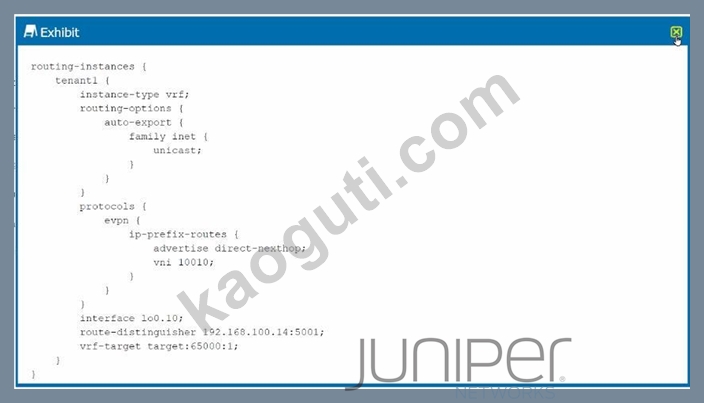
You want to enable the border leaf device to send Type 5 routes of local networks to the border leaf device in another data center. What must be changed to the configuration shown in the exhibit to satisfy this requirement?
- A. Change: 5001 in the route-distinguisher to : 10010.
- B. Add a VLAN configuration with an 13-interface to the tenant1 routing instance.
- C. Add encapsulation vxlan to the evpn hierarchy.
- D. Move vrf-target target: 65000:1 to the evpn hierarchy.
答案:D
解題說明:
In this scenario, you want the border leaf device to advertise Type 5 EVPN routes to another border leaf in a different data center. Type 5 routes in EVPN are used to advertise IP prefixes, which means that for proper route advertisement, you need to configure the correct settings within the evpn hierarchy.
Step-by-Step Analysis:
* Understanding EVPN Type 5 Routes:
* EVPN Type 5 routes are used to advertise IP prefixes across EVPN instances, which allow different data centers or networks to exchange routing information effectively.
* VRF Target Setting:
* The vrf-target configuration is crucial because it defines the export and import policies for the VRF within the EVPN instance. For EVPN Type 5 routes to be advertised to other border leaf devices, the vrf-target needs to be correctly configured under the evpn hierarchy, not just within the routing instance.
Command to solve this:
move vrf-target target:65000:1 to evpn
* Other Options:
* Option B:Adding a VLAN configuration would not address the requirement to advertise Type 5 routes.
* Option C:Adding VXLAN encapsulation may be necessary for other scenarios but does not directly address the Type 5 route advertisement.
* Option D:Changing the route-distinguisher will differentiate routes but does not impact the advertisement of Type 5 routes to other data centers.
By moving the vrf-target to the evpn hierarchy, you enable the proper route advertisement, ensuring that the Type 5 routes for local networks are shared with other data center border leaf devices. This is aligned with best practices for multi-data center EVPN implementations, which emphasize the correct placement of routing policies within the EVPN configuration.
問題 #15
Which parameter is used to associate a received route with a local VPN route table?
- A. route-distinguisher
- B. route-target community
- C. VLAN ID
- D. VNI
答案:B
解題說明:
* Understanding VPN Route Table Association:
* In MPLS/VPN and EVPN networks, theroute-target communityis a BGP extended community attribute used to control the import and export of VPN routes. It associates received routes with the appropriate VPN route tables on the PE (Provider Edge) routers.
* Function of Route-Target Community:
* The route-target community tag ensures that routes are imported into the correct VRF (Virtual Routing and Forwarding) instance, allowing them to be correctly routed within the VPN.
Conclusion:
* Option A:Correct-The route-target community is used to associate received routes with a local VPN route table.
問題 #16
......
想更快的通過JN0-683認證考試嗎?快速拿到該證書嗎?KaoGuTi考古題可以幫助您,幾乎包含了JN0-683考試所有知識點,由專業的認證專家團隊提供100%正確的答案。他們一直致力于為考生提供最好的學習資料,以確保您獲得的是最有價值的Juniper JN0-683考古題。我們不斷的更新JN0-683考題資料,以保證其高通過率,是大家值得選擇的最新、最準確的Juniper JN0-683學習資料產品。
JN0-683考試證照: https://www.kaoguti.com/JN0-683_exam-pdf.html
- JN0-683認證考試問題與答案 ???? 到【 www.newdumpspdf.com 】搜索《 JN0-683 》輕鬆取得免費下載JN0-683 PDF題庫
- 最有效的JN0-683考題寶典,免費下載JN0-683學習資料得到妳想要的Juniper證書 ???? ▷ www.newdumpspdf.com ◁提供免費➠ JN0-683 ????問題收集JN0-683考試證照綜述
- 最新的JN0-683考題寶典和資格考試中的領先提供商和無與倫比的JN0-683:Data Center, Professional (JNCIP-DC) ???? 到[ tw.fast2test.com ]搜尋⇛ JN0-683 ⇚以獲取免費下載考試資料JN0-683資訊
- 通過率高的JN0-683考題寶典,真實還原Juniper JN0-683考試內容 ↖ 請在✔ www.newdumpspdf.com ️✔️網站上免費下載[ JN0-683 ]題庫JN0-683考試證照綜述
- JN0-683考試大綱 ???? JN0-683最新題庫 ???? JN0-683指南 ???? 在⇛ www.pdfexamdumps.com ⇚網站上查找➥ JN0-683 ????的最新題庫JN0-683權威認證
- 完整包括的JN0-683考題寶典 |第一次嘗試輕鬆學習並通過考試和一流的JN0-683:Data Center, Professional (JNCIP-DC) ???? 立即到▶ www.newdumpspdf.com ◀上搜索{ JN0-683 }以獲取免費下載JN0-683最新題庫
- JN0-683權威認證 ???? JN0-683考題 ???? JN0-683題庫 ???? ( tw.fast2test.com )提供免費➽ JN0-683 ????問題收集JN0-683考題免費下載
- 最受推薦的JN0-683考題寶典,免費下載JN0-683考試題庫得到妳想要的Juniper證書 ↩ ⏩ www.newdumpspdf.com ⏪是獲取➡ JN0-683 ️⬅️免費下載的最佳網站JN0-683資訊
- 通過率高的JN0-683考題寶典,真實還原Juniper JN0-683考試內容 ???? 在▷ www.newdumpspdf.com ◁網站上查找☀ JN0-683 ️☀️的最新題庫JN0-683認證
- JN0-683考試證照綜述 ???? JN0-683資訊 ???? JN0-683考試證照 ???? 免費下載( JN0-683 )只需進入⮆ www.newdumpspdf.com ⮄網站JN0-683考試證照
- 最有效的JN0-683考題寶典,免費下載JN0-683學習資料得到妳想要的Juniper證書 ⏸ 進入“ tw.fast2test.com ”搜尋⏩ JN0-683 ⏪免費下載JN0-683測試題庫
- tbookmark.com, zubairfjtj822126.tkzblog.com, loanbookmark.com, phoebelcyd821823.blogripley.com, reganekkj987301.nizarblog.com, kalevxit257157.theobloggers.com, bookmarkingbay.com, tools-directory.com, www.stes.tyc.edu.tw, gregorysbkj805974.wikikali.com, Disposable vapes
從Google Drive中免費下載最新的KaoGuTi JN0-683 PDF版考試題庫:https://drive.google.com/open?id=14aMTcF3ILfY6ep94R6V4NULcr2Dq2ZAo
Report this wiki page